
Solar energy is changing how we think about power. Costs have come down, the technology has improved, and more homeowners are turning to clean energy to manage rising utility bills.
But what happens when the sun goes down or the grid goes out? Solar alone can’t keep things running. Most homes use the most electricity early in the morning and again in the evening, when solar panels aren’t producing much power. During outages, grid-tied solar systems shut off for safety. That gap between when energy is generated and when it’s needed has always limited what solar can do on its own.
A typical grid-tied system can still reduce energy costs, but it remains dependent on outside power whenever production drops. Solar alone lowers bills and emissions, but it doesn’t deliver true energy independence.
Home battery systems are beginning to change that. Instead of sending excess energy back to the grid, homeowners can store it and use it later during evening peaks, outages, or when rates spike. What used to be daytime-only power becomes available on demand.
Solar + Battery Backup Changes the Equation
Solar battery backup systems have changed how solar energy functions in everyday life. Solar panels still generate electricity when sunlight is available, but now excess energy is stored during the day and made available later. This turns solar power into a resource that aligns with real-world demand, not just daylight hours.
The impact is two-fold. Homeowners gain savings, protection, and continuity of lifestyle even when the grid is down. At the same time, the aging electrical grid experiences less stress as energy demand is partially met locally instead of entirely through a centralized utility company.
Perfect Timing: Lower Solar Panel Costs, Higher Yield Technology, and Residential Battery Systems Working Together
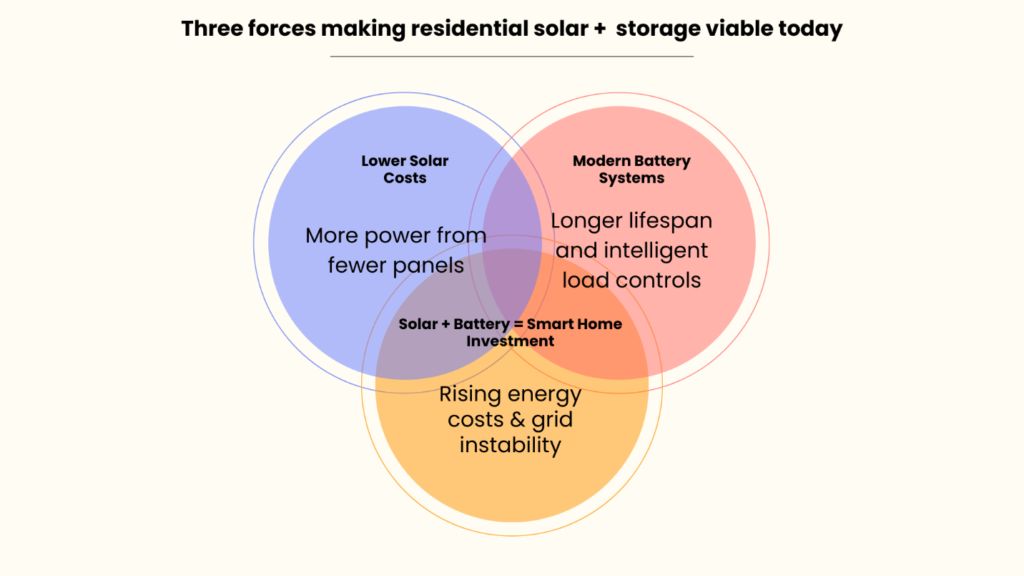
There has never been a better moment for homeowners to consider a solar battery backup system. Energy costs continue to rise, weather events driven by climate change are becoming more frequent, and grid infrastructure in many regions is aging faster than it is being replaced. Meanwhile, both solar and battery technologies have matured.
Modern solar panels produce more energy in less space, perform better in low-light conditions, and last longer than earlier generations. Battery systems have improved efficiency, lifespan, and safety. Importantly, there is no looming technology disruption that would suddenly make today’s solar and battery systems obsolete.
Battery backup eliminates the gap between energy production and energy use. Power generated earlier in the day can be stored and used hours later when demand is highest and electricity rates are often at their peak. This is not just about convenience. It directly reduces reliance on fossil fuel generation during those high-demand periods.
The combination of solar and battery systems turns homeowners into active participants in energy management. Instead of passively buying electricity at the most expensive times, homeowners can choose when to store, use, or conserve energy. This level of control was simply not possible before and it fundamentally changes the value of renewable energy at the residential level.
Policy Momentum Is Catching Up to Battery Storage
In addition to technology and economics, energy policy is beginning to reflect the growing role of residential battery storage. Several states now recognize that home batteries are not just a personal resilience tool, but a practical way to reduce peak demand, stabilize the grid, and limit reliance on fossil-fuel-powered emergency generation.
California has taken the most visible step by implementing legislation and incentive programs that actively encourage residential battery adoption. These programs are designed to support grid reliability during peak demand and extreme weather events, while reducing emissions and strain on centralized infrastructure. Other states are watching closely. Washington State and several others are evaluating similar approaches that would lower the cost of adoption and create frameworks for homeowners to participate in grid support through stored energy.
The direction of travel is clear. It reinforces that residential battery systems align with where energy planning is headed, while already delivering immediate benefits in resilience, savings, and energy control.
Residential Solar Battery Adoption: Homeowners Are Growing in Confidence
Homeownership naturally comes with planning for contingencies. People think about how to protect their family, how to maintain comfort, how to manage long-term costs, and how to make responsible decisions for future generations. Energy plays a role in all of those considerations.
For many homeowners, the motivation to install solar is not purely financial. It includes a desire to reduce environmental impact, create stability for their household, and prepare for uncertainty. Animals, food storage, medical needs, remote work, and communication all depend on reliable electricity.
Battery backup solutions now address the reliability question directly. With storage in place, essential household systems continue to operate even when the grid goes down. Energy can be used strategically at a lower cost, and power is available during outages without relying on fuel-based generators.
This reliability transforms solar from something conditional into something dependable. Confidence grows when homeowners know that their energy system works regardless of grid conditions, weather disruptions, or changing utility policies. That confidence is driving adoption more than incentives alone ever could.
Battery Systems Do More Than Power a Home. They Help Stabilize the Grid
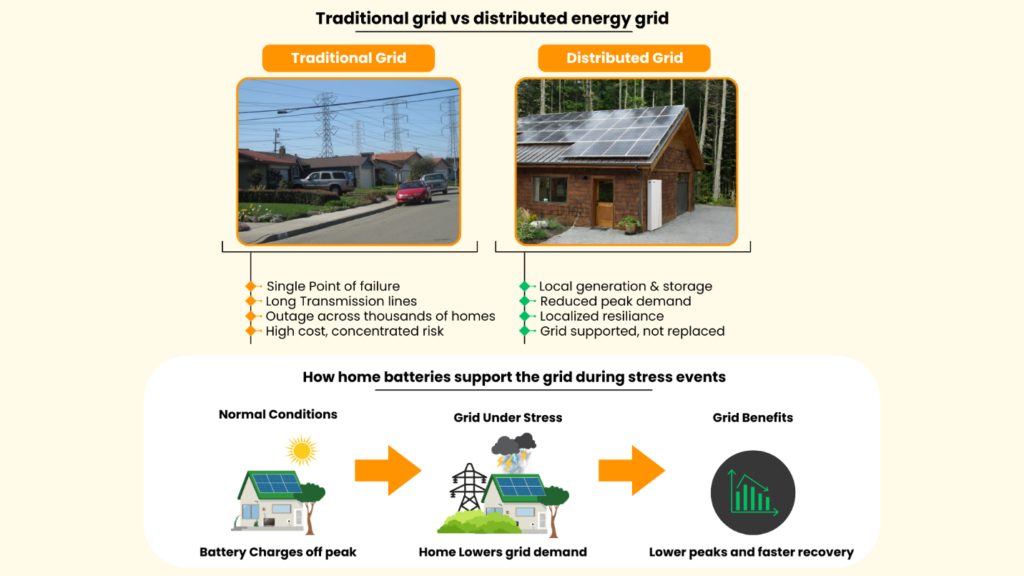
While homeowners gain independence and security, battery storage also plays a stabilizing role at the grid level. Utilities are under increasing pressure to balance supply and demand as climate change introduces more volatility through heat waves, storms, and seasonal extremes.
Traditional grid management has relied heavily on fossil fuel generation to respond to sudden demand spikes. These sources are expensive to operate and among the highest emitting forms of electricity generation. They are effective in emergencies but environmentally costly.
Solar battery backup systems reduce that pressure. Stored energy can be used locally during peak demand periods, which lowers strain on centralized generation. As residential storage capacity increases, utilities gain flexibility. Higher levels of renewable generation become easier to manage without sacrificing reliability.
Solar Battery Backup Systems Shift Energy Local
Battery-backed solar systems also support a more decentralized energy model. Sunlight is captured, stored, and consumed closer to where it is used. This reduces transmission losses, eases strain on long-distance infrastructure and improves overall system efficiency.
As more homes adopt battery storage, the grid becomes more resilient in an incremental but meaningful way. Instead of a single point of failure affecting large areas, energy is distributed across thousands of smaller systems.
Looking ahead, this shift opens the door to community-based energy models, neighborhood microgrids, and shared resilience strategies. Homes and communities could support one another during outages, reducing recovery time and dependence on emergency fossil fuel generation.
Conclusion
Solar energy has always faced the same basic challenge. When the sun isn’t shining or the grid goes down, the power traditionally hasn’t been there. For many homeowners, that limitation has been hard to overlook, even as solar technology itself has improved.
Battery storage changes that reality. It allows solar energy to be dependable and available when it’s actually needed, not just when conditions are ideal. Homes can remain powered during outages, and stored energy can be used strategically instead of relying entirely on the grid during peak demand.
Renewable energy works best when people can count on it in the morning, in the evening, and during grid power failures.